
 This article delves deep into the views of an IEEE columnist who thinks 5G APIs will fail. Here, I will try to argue approaches to 5G APIs and potential downfalls and limitations that may be present in the industry’s current approach. I will try to spot potential improvements that can be made to the current approach, from arguments that may be considered purely theoretical.
Arguments Against 5G
Some claim that telecommunications is a slow industry, that is deeply regulated and is monopolized by a few mobile network companies. People argue that this results in a field that lacks innovation and where the speed of growth is low.
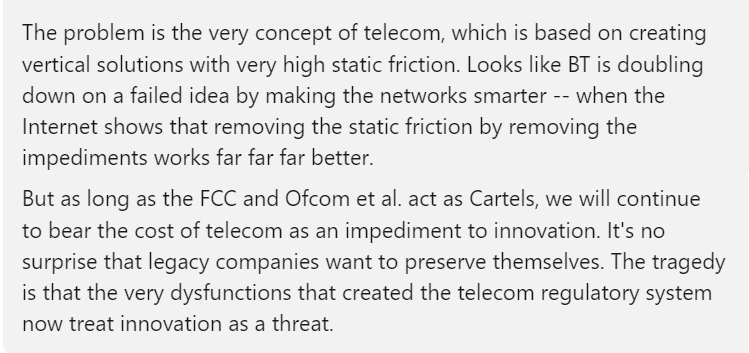
IEEE columnist’s comment about 5G APIs
A Dystopian Reality
This IEEE columnist’s views come across as counter-productive for developments in telecommunications. It dismisses the possible innovativeness in developing an open tech initiative in the 5G Open Gateway APIs.
In my opinion, it’s always better to tend towards optimism when discussing innovation-driven initiatives.
When faced with such harsh and dismissive arguments in favor of disestablishing the current telecommunications industry, I wanted to find out what they proposed to replace it.
In their 2021 article published in the IEEE Consumer Electronics Magazine titled “Consumer Technology vs 5G”, the columnist argues that 5G APIs are an attempt by Telcos to hijack applications that could be developed, owned, and operated freely by the people, without having to depend on MNOs’ networks for life.
They claim that Telcos, trying to monetize specific aspects of connectivity, are venturing into the world of applications (and cloud) to tie them down to their network. By making them network-dependent, they will assume ownership of applications and their services, trying to capitalize on facilities of connectivity that have long been claimed by the Internet or CPaaS.
Innovative Open APIs and the Danger of Dedicated Connectivity
While the maliciousness of 5G APIs is up for debate, we could take treat this as a chance to discuss the 5G business model. ‘Non-genericness’ might be one of the reasons behind the slow adoption and revenue growth of 5G. Not having a good market fit or clear applications that could benefit from 5G was a major problem for adoption in the early stages. To change this, the industry is working hard to nurture applications that can benefit from using 5G networks. It is a challenge for marketing and for the engineers to unlock the true potential of what they have constructed. Who knows what new tech could 5G enable?
To this end, MNOs are working on a framework that can facilitate the adoption and growth of 5G. They’re developing Open APIs to foster growth in the 5G Smart Application landscape. As 5G applications are built upon the premise of having a strong and fast 5G connection, APIs are built to ensure that this connection stays fast and reliable.
Here’s a list of some 5G applications, some already realized and some not:
-
remote (VR-powered, even) surgeries using 5G
-
connecting autonomous smart cars and such IoT
-
mobile gaming at the edge (cloud gaming)
It is clear that these applications need a razor-sharp network to function. There are numerous APIs that help turn them into reality. For example, the Quality-on-Demand API of the GSMA provides specific network quality for the user’s application demands. This functionality might be used in drone search-and-rescue missions and online mobile gaming. I wrote about it in my post here.
When developing the 5G Open APIs, the industry should take special care to not hinder innovativeness. A possible downfall would be to tie the whole business model of 5G to creating dedicated apps. Instead, MNOs should focus on creating a level playing ground for all developers who want to use their connectivity infrastructure. After reading the IEEE article, this point became more important to highlight, as it argues that the open approach of the Internet allowed it to achieve a lot of revenue that the telecommunications industry had long failed to realize.
The article mentions the early technologies of video calling in the 20th century, like AT&T’s Picturephone, that never managed to take off. The author compares this to the video calling services enabled by the Internet in the 90s. They argue that the Internet achieved what telecommunications couldn’t achieve in 40 years by having a generic, “Best Efforts” approach to connectivity and applications.
The goals of Open APIs are exactly in accordance with what made the Internet ‘boom’ in the early 2000s. It is a gateway to the future for MNOs, which will see more openness in their relationship with developers and the application landscape.
A Not So ‘Grimdark’ Future
5G is here and it’s here to stay. It would be in our best effort to try establishing innovative spaces to guide it well, instead of looking for innovation only when it makes money and as a new profit channel to be captured and owned.
Telcos should take an example from the Internet and avoid business plans that focus on forcing applications to depend on a certain service to create profitability.
What do you think? Are telco APIs a step forward in creating an open playing field with MNOs, or are they a new method for monopolizing connectivity?
[1]B. Frankston, “Consumer Technology Versus 5G,” IEEE Consumer Electronics Magazine, vol. 10, no. 2, pp. 43–50, Mar. 2021, doi: 10.1109/mce.2020.3037418.